

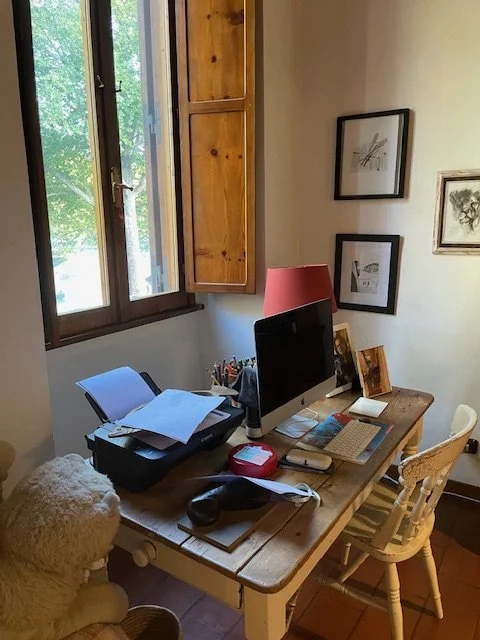
My desk overlooking the Tiber
Research and Exploring The Space Between Language and Gut
Sitting at my desk in Rome, creating a class on the poetic wonder of the Periodic Table and watching the River Tiber rolling by, I stumbled upon an article about Dmitri Mendeleev’s mother. It was 2021 I had never heard of Maria Mendeleeva, and frankly I hadn’t given her a moment’s thought. Yet, by the time the sun had set behind domes and rooftops, an indelible picture was painted on my mind. The brief article about the Russian genius’s mother, written by the Australian chemist Alf Larcher, had touched my heart.
Maria Mendeleeva was born in January, 1793. Her mother died months later. She and her older brother were raised in Siberia by a loving, mentally fragile father and their nanny. Maria was a clever child and hungered for new knowledge and education. However, due to her sex, she was denied access to formal school. Undaunted and supported by her father’s library, she taught herself. Aged sixteen, she married Ivan Mendeleev, a gently radical teacher, and she bore seventeen children, of whom Dmitri was the youngest. When Ivan went blind, Maria took over her grandfather’s run-down glass factory to support her family. Life in 19th-century Siberia was harsh, to say the least, and her journey was elemental. After losing her fragile livelihood to fire, she determined her teenage son should not languish in the backwaters. Thus, despite being infected with tuberculosis, widowed and impoverished, she undertook a perilous two -thousand -mile journey, with Dmitri and one of his sisters, over the Urals to get to her son to university. Larcher’s admiration and affection for Maria radiated from his article, and I needed to know more about this woman and her family.
Just as there were gaps in Mendeleev’s first periodic table of the elements, there were tantalising gaps in Maria’s story. Who influenced her childhood? What was her nanny’s story? Maria’s marriage was it a love story? What drove her lifelong curiosity? How did she maintain her passion for female education against so many odds? Why was Ivan sacked from a prestigious job? Dmitri was the youngest of a tribe of siblings. Who were Maria’s other children? As a mother of five, I knew first-hand that families are evolving organisms energised by entangled stories meshing, diverging, nourishing, starving, wounding, healing, loving and inspiring: unique familial networks reach back into the deep past and forward into an unpredictable future. Yearning to meet each Mendeleev, I was frustrated by stale information: all I could find were different versions of the same events. But a telephone call with a friend changed everything.
He told me about a rare book of family letters written between 1837 and 1850 and compiled by one of Maria’s granddaughters. This was gold. Using DeepL to translate, and supported by my Russian students and friends, I read the letters over and over again, immersing myself in the Mendeleev’s daily life. The little narratives were emotionally visceral and told an epic domestic story. The shifts in tone, depending on to whom Maria was writing, revealed the turmoil of her inner life and her keen emotional intelligence. Household members and acolytes fascinated me as much as the family. I had to get under the covers of each story. Hunting down the details of Maria Mendeleeva’s life was complicated, but caring about her and the people she loved was easy: I grew to love them too. In time the book became a novel. Yet still there were many gaps to fill. Context was critical.
What socio- political events would have affected the family? What information would have been available? How long would it have taken for them to receive it? What books would have been in her ever-expanding library? What food would they have eaten? How was glass made? What scientific innovations would she have been familiar with? The list of questions grew longer every day. Sharing Maria’s insatiable curiosity, I delved deep and during the next four years tantalising details emerged from biographies, 18th- and 19th-century scientific papers, historical lectures, historical papers, letters, and precious primary sources: scratchy Cyrillic letters on yellowed official documents revealed facts about Ivan’s working life that helped me to colour in between the lines with confidence. I delighted in every detail. Trifles carried tender messages. Little truths revealed deep experience. Nothing was insignificant.
During my research, a nuanced word taught me a valuable lesson about the connection between language and gut. The word was cult. It carried dark connotations. It appeared in all translations. After asking Russian friends to verify the meaning, and speaking to academics who were experts in 19th-century Siberian religious cults, there was no getting away from the fact that one of Maria’s daughters had joined a cult and, in doing so, had broken her mother’s heart. That is what language told me. But my gut knew language had failed to bridge the space between experience and expression. As a novelist, the darker story offered rich pickings, but by then I had learned to honour the Mendeleev family’s values. I understood the strength of Maria’s faith and the profound role Eastern Orthodox Christianity played in Ivan’s life. No imaginative leap led me to believe their principled daughter would have joined a cult. So, I waited. A year later, while reading a paper about Dmitri Mendeleev’s return to the village where his mother had run her glass factory, it was noted that one of his sisters, guided by one of Maria’s friends, had become devoted to the teachings of the renegade missionary Michael Glukharev. Here at last was solid ground. Glukharev’s controversial, yet humanitarian ideals meshed with many Mendeleev family principles, and I had read letters exchanged between Maria and a friend who had declined marriage to follow an egalitarian missionary’s teachings. Things were falling into place. I was glad I had followed my gut and waited. Fact was more interesting than fiction.
The drama of the narrative required no embellishment: it was driven by real-life events that tumbled one upon another, at times so rapidly that I needed to give the reader a respite. The evolution of Mendeleev’s dynamic marriage was shaped by moral, environmental, emotional and socio-political challenges. Their story was intensely human: they loved and struggled while juggling the needs of self and other, and, as a mother, I identified with Maria’s flaws and frustrations as easily as I did with the couple’s parental mistakes. The challenges the 19th-century family encountered were familiar. However, during my research, I encountered a ‘fact’ that was both an embellishment and an injustice.
It was said that Dmitri was Maria’s favourite child. I found no data to support that. It was clear she and Ivan loved their children with equal passion. It was true that, as the youngest, Dmitri held a privileged place in the family, and it was true that Maria’s final hopes and dreams lay with him, but Ivan and Maria loved and worried about all their children. I was to discover that it was the Mendeleev’s oldest son Vanechka, about whom little is commonly known, whose story impacted the trajectory of family life. The more I learned about the troubled boy, born into a grieving family, the more I sympathised with him. Soon I realised Vanechka’s experience was pivotal. Dmitri was to become the famous genius, but he was part of a close-knit tribe of siblings each supported by parents who shared a complex, maturing love for each other and their family.
Did Ivan and Maria view the world from the same perspective? Of course not. In their own way Ivan and Maria navigated working life, domestic life, the impact of grief, fulfilling personal desires, and parental hopes. 19th- and 21st-century challenges come in many flavours, but the basic ingredients are the same.
Writing about Maria Mendeleeva has been humbling and enriching. I will be forever grateful to the chemist on the other side of the world who cared enough to write an article about a forgotten woman in Siberia and post it online. Today many women are living unheard and unseen lives: their stories are waiting to be told. We are entangled in the lives of those unknown to us. Our small lives generate large ripples that undisturbed spread outwards towards infinity.
https://www.saltpublishing.com/blogs/house-magazine/the-space-between-language-and-gut
THINKING IN COLOURS
I think in colours and smells. When I start a scene in a book, it has a wash of colour: sometimes deep red, burnt orange with a splash of turquoise; sometimes my mind fills with greens and cobalt blue. And then there are grey moments slashed with charcoal. Words land among colours and the smells. I can smell each character's skin and hair; I sense molecules in the air they breathe, carrying the scent of toast, rain, or melting candle wax: tiny sensory details keep me grounded in the moment.
Writing is done in isolation, and yet it is a collaborative experience. Trying to create pictures in strangers' heads is an odd practise. I will never know the person who picks up one of my books. I don't know their story and what they carry with them, and yet we share intimate time. I think of them as I write. I care for them. And I understand that for all my effort a degree of failure is inevitable. The picture I paint will not be the one that later forms in the reader’s head. For each imagination is different. Each person brings their own experience to my story, filling in the spaces between my words and their world.
Sometimes readers will write to you, but mostly reading is private. Intimate. The story is the thing. The writer creates the vessel in which the reader travels. What the explorers find along the way depends on who they are and where they are in their life.
In my first book, Under the Camelthorn Tree, a memoir, I played with time and space – moving between countries back and forth across the years – but colours played their part. Something multicoloured had been dropped. I saw fragments of geometric shapes, with sharp edges, chips of colour, slices of ceramic. Some splinters were hiding in the shadows. Where there was darkness, I had to let in light. After finishing the story, I started my favourite part of the journey: the editing, carving, cutting and reshaping. I colour-washed each chapter. Too much dark side by side, and I dropped in a yellow chapter to ease the way. Too much light, and I put in shadows. When inky black was needed, and a hard punch winded the reader, I slipped in a green oxygenating chapter so they could catch their breath and feel the space between the words. Time moved back and forth in jerks made fluid by colour. Moments captured.
The Maternal Element was different: time moved easily across the decades and with time came threads of colours: mulberry, cranberry, burnt umber, blood orange and smoke. Frayed threads enclosed in tapestry, slowly unravelling, and outside white snow stretched towards infinity, marked by urine stains and tracks leading away: always away.
Space was my challenge: The reader spent so much time inside. I had to take them out – on a walk by a river – on a carriage ride – into a forest – or looking through windows into the outside world. In this book, colourful lives were confined indoors, in a land so vast it had no edges, and all the colours were enclosed in white. It is white that elementality exposes the constraints of human vision. The world we cannot see lives outside the whiteness.
When I write I am living with colours and smells, and I fit in words to tell a story. Sharp, clean words painting pictures in strangers' heads. Strangers who will fill in the space between my words with their experience.
I always wonder what they see.
August 2026